Overview of the Study
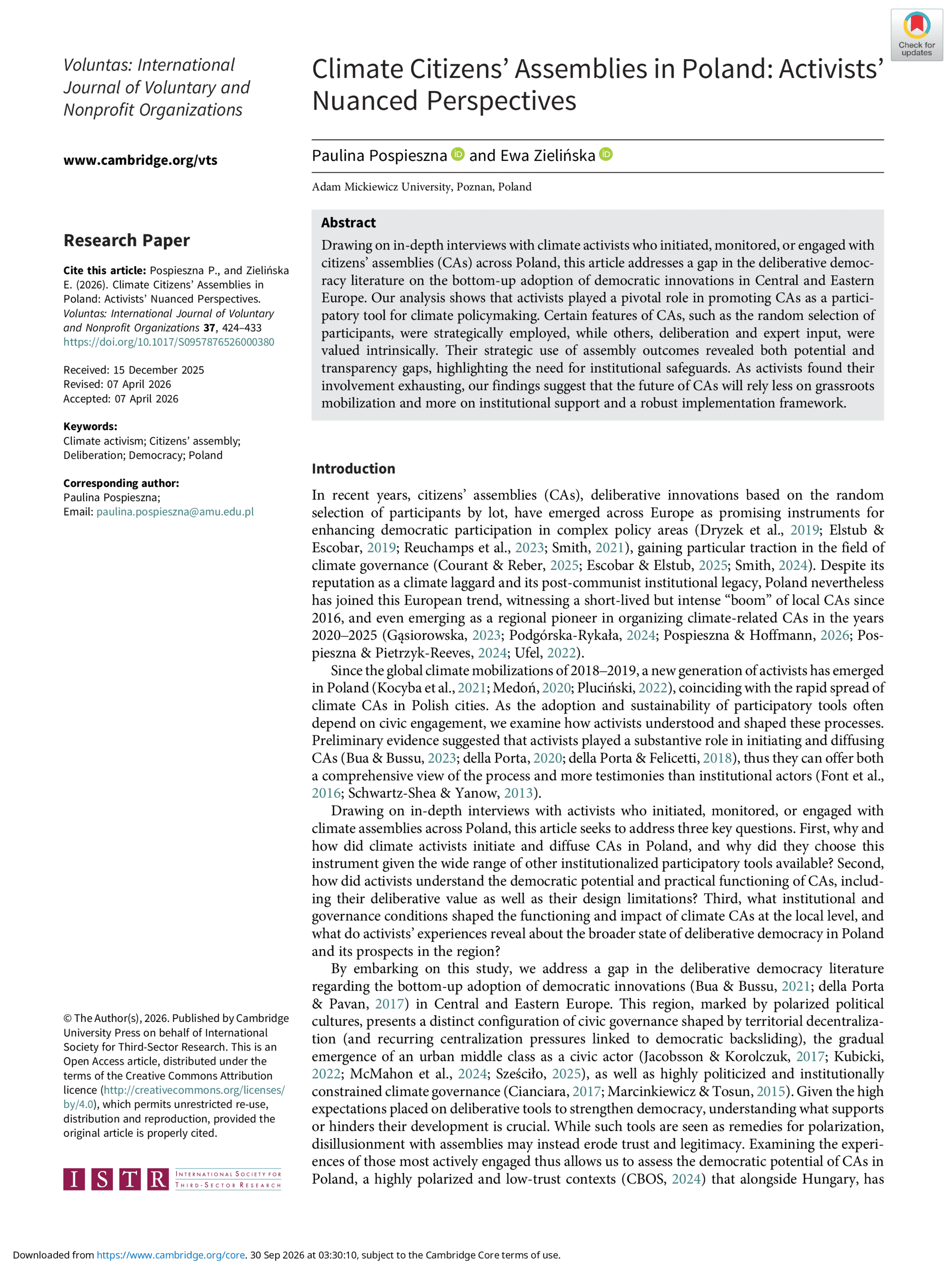
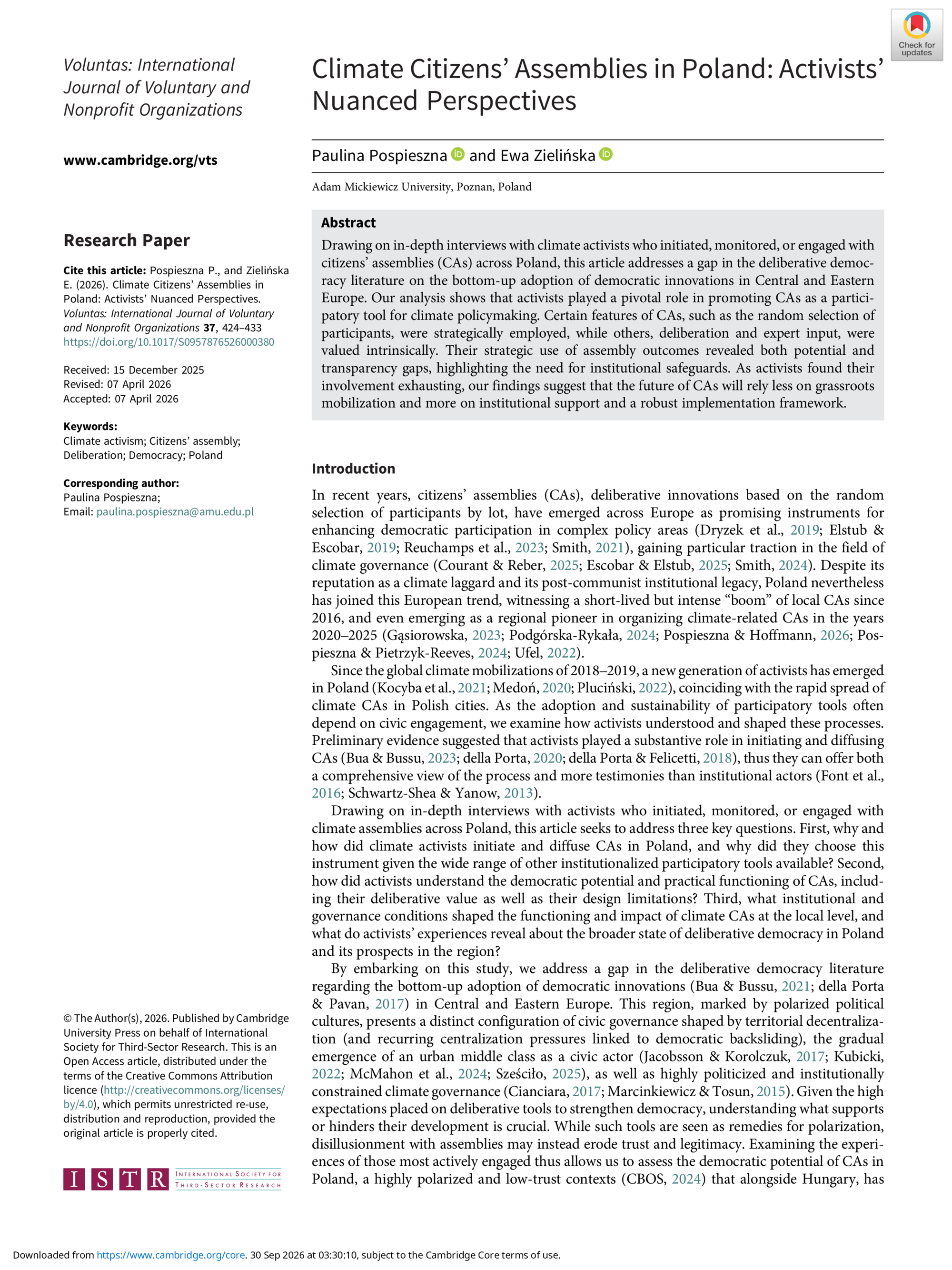
The article “Climate Citizens’ Assemblies in Poland: Activists’ Nuanced Perspectives” is published in Voluntas: International Journal of Voluntary and Nonprofit Organizations, a peer‑reviewed journal focused on civil society research. Authors Paulina Pospieszna and Ewa Zielińska are researchers at Adam Mickiewicz University in Poznań, with expertise in climate activism and deliberative democracy. The paper examines how climate activists in Poland have initiated, shaped, and evaluated citizens’ assemblies (CAs) as a tool for climate policy making.
Research Motivation
Activists sought participatory mechanisms that could lend democratic legitimacy to climate initiatives in a politically polarized and low‑trust environment. The study fills a gap in literature on bottom‑up adoption of democratic innovations in Central and Eastern Europe, where most research has focused on top‑down reforms.
Methodology and Sample
The authors conducted 13 semi‑structured in‑depth interviews between January and March 2025 with activists from national and local groups, including Extinction Rebellion, Youth Climate Strike, Polish Green Network, and local coalitions such as Zazieleń (Poznań) and Wesoła (Kraków). Interviewees represented a range of cities (Warsaw, Łódź, Kraków, Wrocław, Poznań, Gdańsk, Lublin, Rzeszów) and roles (initiators, monitors, participants). Data were coded deductively for references to CAs, their phases, and sentiment, then inductively to uncover broader themes.
Key Findings: Activist Strategies
- Activists viewed CAs as a strategic tool to amplify influence beyond petitions, leveraging random citizen selection to gain broader legitimacy.
- The “80 % support threshold” emerged as a benchmark for political weight, with activists believing it increased the likelihood of policy uptake.
- CAs were employed to generate expert‑informed arguments, test public opinion, and build coalitions across movements.
Design Strengths and Weaknesses
Strengths identified by participants include random selection of participants, deliberative dialogue, and the potential for knowledge exchange between experts and lay citizens. Weaknesses involve:
- Lack of legally binding enforcement mechanisms; recommendations rely on personal commitment of officials.
- One‑off nature of most assemblies, with limited integration into broader policy cycles.
- Insufficient budgeting, scheduling, and follow‑up structures, leading to variable implementation.
- Limited public awareness beyond the assembly itself, especially outside Warsaw.
Institutional Context
Poland’s post‑communist decentralization created extensive formal powers for municipalities, yet clientelist practices and centralized political pressures persisted. While local governments occasionally commissioned CAs (e.g., Gdańsk, Lublin, Łódź, Wrocław, Warsaw, Poznań, Kraków), the assemblies were often weakly embedded in long‑term governance frameworks. Activists noted that successful outcomes depended more on personal networks than on institutionalized procedures.
Impact on Climate Policy
The study reports mixed results: some assemblies influenced local climate documents (e.g., Warsaw’s energy‑efficiency plan) and secured references in strategic plans, while others saw recommendations ignored or diluted. Activists highlighted that the exhaustion of volunteer effort and the absence of systematic follow‑up reduced sustained impact.
Future Outlook
Respondents anticipate that the sustainability of CAs will hinge on stronger institutional anchoring, transparent standards for implementation, and dedicated resources. They envision a shift from activist‑driven initiation toward routine, legally supported deliberative mechanisms within municipal administrations.
Data Availability and Funding
Research data are deposited in the University of Adam Mickiewicz repository (doi:10.60629/23ky‑g603). The project received funding from the National Science Centre, Poland (grant UMO‑2021/42/E/HS5/00155) under the “Deliberative Innovations in Central and Eastern Europe” programme. No competing interests were declared.